
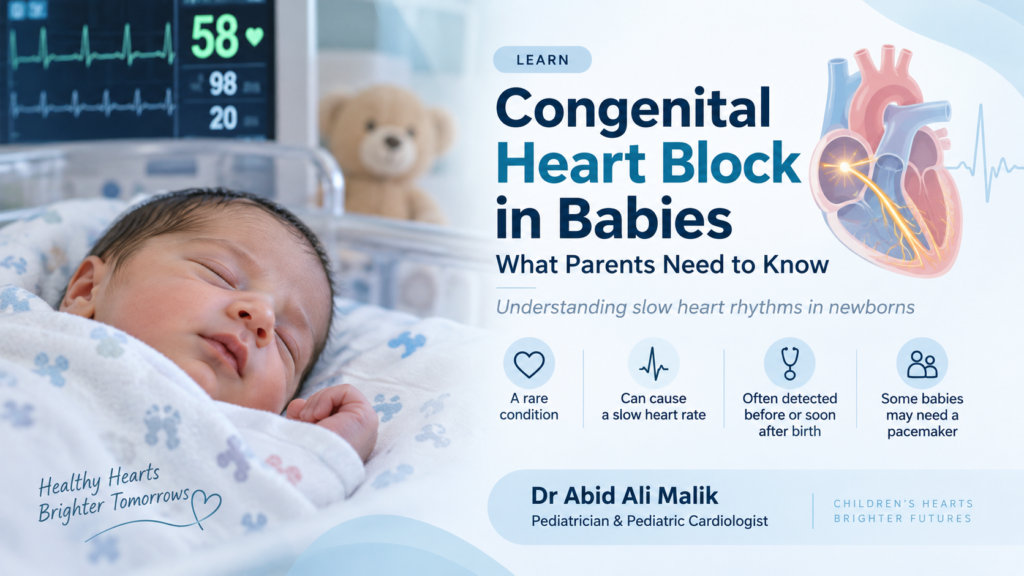
Hearing that your unborn or newborn baby has a very slow heartbeat can be frightening. One possible cause is congenital heart block, a rare problem affecting the heart’s electrical system.
The encouraging news is that congenital heart block can often be recognized before or soon after birth. With careful monitoring and timely treatment, including a pacemaker when necessary, many affected children can do very well.
What Is Congenital Heart Block?
The heart has its own electrical system that controls how fast and regularly it beats. Normally, an electrical signal begins in the upper chambers of the heart and travels to the lower pumping chambers.
In complete congenital heart block, these electrical signals do not pass normally from the upper chambers (atria) to the lower chambers (ventricles). As a result, the baby’s heart may beat much more slowly than expected.
This condition is also called congenital complete atrioventricular (AV) block.
Can It Be Detected During Pregnancy?
Yes. Congenital heart block may first be suspected during a routine pregnancy examination when the doctor notices persistent fetal bradycardia, meaning that the baby’s heart rate is unusually slow.
Further assessment may include:
- Detailed fetal ultrasound and fetal echocardiography
- Assessment of the baby’s heart rate and rhythm
- Evaluation of heart function and signs of fetal heart failure
- Blood tests for the mother, particularly when an autoimmune cause is suspected
Early recognition is important because it allows the obstetric, neonatal and pediatric cardiology teams to make a delivery and postnatal management plan before the baby is born.
Why Does Congenital Heart Block Happen?
There are several possible causes.
An important cause is the presence of certain maternal autoimmune antibodies, particularly anti-Ro/SSA and anti-La/SSB antibodies. These antibodies can cross the placenta and, in a small proportion of pregnancies, affect the electrical conduction system of the developing baby’s heart.
These antibodies may occur in mothers with autoimmune conditions such as systemic lupus erythematosus (SLE) or Sjögren’s syndrome.
Importantly, some mothers may feel completely well and may not know that they carry these antibodies. Occasionally, the baby’s heart block is the first clue that leads to further evaluation of the mother.
Congenital heart block can also occur in association with structural congenital heart abnormalities or, in some cases, without an identifiable cause.
What Happens After the Baby Is Born?
A baby suspected of having congenital heart block should be assessed carefully after birth.
Doctors may perform an ECG to confirm the type of heart block and an echocardiogram to assess the structure and pumping function of the heart.
The baby’s heart rate, oxygen level, blood pressure, feeding, circulation and overall clinical condition are monitored closely.
Some babies remain stable despite a slow heart rate, while others may develop poor circulation or reduced heart function.
Does Every Baby Need a Pacemaker?
No. The decision is individualized.
Doctors consider several factors rather than the heart rate alone, including the baby’s symptoms, ventricular rate, heart function, circulation and whether there are other heart abnormalities.
However, a very slow heart rate accompanied by poor cardiac output, symptoms or deterioration of heart function may make cardiac pacing necessary.
In an emergency, a temporary pacemaker may be used to stabilize the baby. If ongoing pacing is required, a permanent pacemaker can then be implanted.
A pacemaker is a small device that delivers electrical impulses to help the heart maintain an appropriate rhythm.
Can Such a Small Baby Really Have a Pacemaker?
Yes.
Pacemaker implantation in a newborn is highly specialized and requires careful planning because of the baby’s very small size. It usually involves close cooperation between pediatric cardiology, neonatology, cardiac surgery, cardiac anesthesia, intensive care and specialized nursing teams.
With appropriate expertise and facilities, pacemaker therapy can provide effective and potentially lifesaving support even in very small newborns.
What Is the Long-Term Outlook?
The outlook varies depending on the cause of the heart block, associated heart abnormalities, heart function and the baby’s overall condition.
Many children with isolated congenital complete heart block who receive appropriate monitoring and pacemaker treatment can grow, attend school and participate in normal childhood activities.
Children with pacemakers require lifelong follow-up with a pediatric cardiology team. Follow-up usually includes pacemaker checks, ECGs, echocardiography and monitoring as the child grows.
When Should Parents Seek Specialist Advice?
If fetal bradycardia is repeatedly detected during pregnancy, specialist assessment should not be delayed. Similarly, a newborn or infant with an unusually slow heart rate, poor feeding, unusual tiredness, breathing difficulty, bluish discoloration, fainting or signs of poor circulation requires urgent medical evaluation.
The Most Important Message for Parents
Congenital heart block is a serious condition, but early diagnosis changes what doctors can do.
Recognition during pregnancy provides an opportunity to plan delivery at an appropriate center, prepare the neonatal and cardiac teams and arrange pacing facilities in advance if they may be needed.
A slow fetal heartbeat should therefore be investigated, not ignored.
This article is intended for parent education and general awareness. It does not replace assessment or medical advice from your obstetrician, pediatrician or pediatric cardiologist.